
Your flight was cancelled an hour ago. You are at the gate with a dying phone, a useless boarding pass, and a connection leaving in ninety minutes. The app keeps spinning. The desk queue snakes around the terminal. So you search for the airline’s customer service number — and the first result hands you a fake airline helpline number, in big bold digits, with the airline’s name right there in the listing. You dial.
A friendly voice answers, uses the airline’s name, and asks for your booking reference. You hand it over — why wouldn’t you? Then comes the bad news: your card was declined, or there’s a rebooking fee, or a “system charge” of a few hundred dollars to pay right now, by card, over the phone. You pay. Only later do you find out they never worked for the airline at all.
That call is the whole scam. A fake airline helpline number is not a wrong number. It is a phone line run by criminals, placed where a stressed traveller will find it first — at the top of a search, inside a polished AI answer, or on a page that looks like the airline’s own site.
Short answer: Never trust a fake airline helpline number just because it came up first in a search or inside an AI-generated answer. Scammers buy ads and plant fake numbers so they appear above the real ones. The only number you can trust is the one on the airline’s own website or app. If the person who answers asks for a card payment, a wire transfer, a gift card, or your password, hang up — that is not how a real airline works.
In This Guide
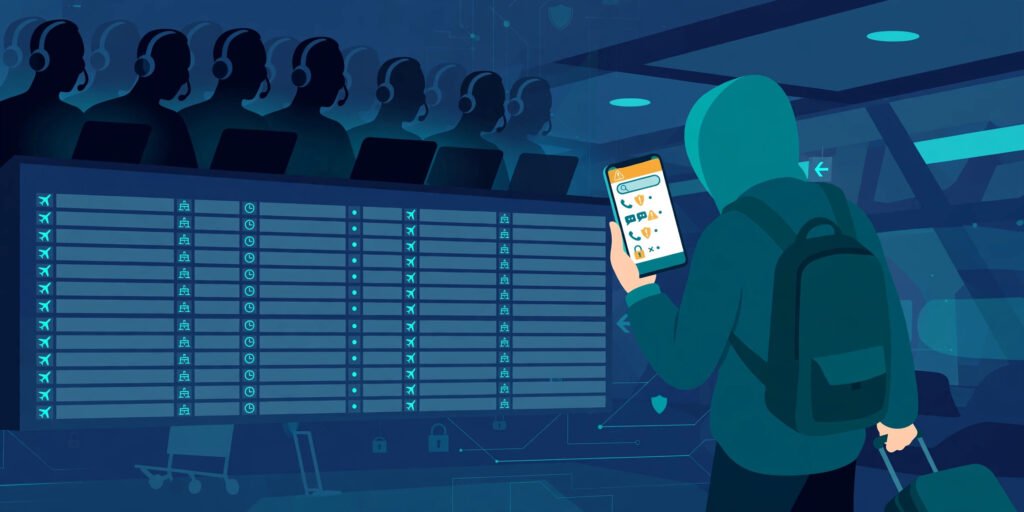
How a Fake Airline Helpline Number Ends Up at the Top of Your Search
The Federal Trade Commission has warned about this exact setup since August 2020. In a consumer alert that year, the FTC said that, based on reports it had received, “some scammers are creating fake customer service information for popular companies and paying for it to show up in your search results.”
Here is the chain. A scammer sets up a phone line and a website that borrows an airline’s name, logo, and colours. Then they pay for a search ad, so their number sits above the airline’s own result. The FTC returned to the subject in April 2025: scammers “might use another company’s name, include the name of a government service, or use misleading tag lines,” and “they might even put their number alongside a trusted company’s name or link to a website that looks official.”
Their goal, the FTC said, is “to get your money or your personal or financial information to steal your identity.” In September 2026 the FTC warned again, in plain language, that “scammers and dishonest businesses sometimes pay to appear at the top.”
The top of the page is for sale. That is the single most important thing to understand about this scam: position in search results proves nothing except that somebody paid, or gamed the system well enough to get there.
The scale is real. The FTC reported in June 2026 that people lost about $3.5 billion to imposter scams in 2025 — nearly three times the figure from 2020 — and that imposter scams made up nearly one in three fraud reports. Business impersonators accounted for nearly $1 billion. The true total is higher, because plenty of victims never report at all.
How the Call Plays Out, Step by Step
Most calls to a fake airline helpline number follow the same script.
Step one: you find the fake airline helpline number. You search for the airline’s helpline, ask an AI assistant, or click a number on a page that looks like the airline’s site. The number is often toll-free. Toll-free means nothing — anyone can buy one.
Step two: they sound like the airline. The person who answers uses the airline’s name, speaks politely, and asks for your booking confirmation number and your name. That feels like proof. It is not — a booking reference is something you just gave them.
Step three: a problem appears that only money can fix. Your card was declined. There is a rebooking fee. A fare difference must be paid now or the seat goes.
In one BBB Scam Tracker report, a traveller called a helpline number shown at the top of an airline webpage, gave their name and confirmation number, and was told their card had been declined. They ended up with an extra charge of more than $2,000 from a third party called “Air Ticket” on top of the real airline charge. The airline later said the flights had been booked by someone who did not work for the airline, simply by logging onto its website — and confirmed the number was not theirs.
Step four: pressure. The seat will be released, the price goes up in ten minutes — everything is urgent, and the only way forward is to pay right now, on this call, by card. A real airline will let you hang up and call back. A scammer cannot afford that, because a second look kills the scam.
Step five: the extras. Sometimes the “agent” asks you to download a remote-access app so they can “fix” your booking on your screen, or asks for your account password, or for a one-time code sent to your phone. The FTC’s 2020 alert warned that scammers “might also ask for your personal information, or to get remote access to your computer.” If a helpline asks for remote access to your device, hang up.
One thing worth saying plainly: the airline is the victim here too — its name and reputation are being used without permission.
Red Flags That Give the Game Away
A fake airline helpline number rarely announces itself, but it leaves fingerprints:
- You have to pay to get help. A real airline does not charge a fee to speak to customer service, and it never demands a wire transfer, a gift card, or cryptocurrency to rebook you. The FTC puts it bluntly: no legitimate company will ask for gift cards, wire money, or your password in exchange for customer service help.
- Your card was “declined” — but only they can see it. If your card really was declined, your bank can tell you. A stranger who insists you try a different card right now is running a script.
- They want a one-time code, a password, or remote access. No airline needs your account password or a code texted to your phone to change a flight. And no airline needs to see your screen. Ever.
- The number came from a search ad or an AI answer. If the result has a small “Ad” or “Sponsored” label next to it, that is a paid placement, not an endorsement. The FTC’s April 2025 advice: scroll past the paid results and check the unpaid ones.
- They found you, not the other way around. The FTC warned about it in July 2024 after the CrowdStrike outage grounded flights worldwide. Scammers crawl social media for posts from upset travellers, then reach out from fake accounts pretending to be airline customer service. If you posted about a delay and a “helpful agent” appears in your replies within minutes asking for your booking number, that is not the airline.
The same instincts apply well beyond airlines — our guide on how to tell if a text is a scam covers the same pattern in messages, and the USPS delivery text scam is a close cousin, aimed at your inbox instead of your phone.
Real Helpline vs. Fake Airline Helpline Number: The Difference in One Look
| What happens | Real airline helpline | Fake helpline |
|---|---|---|
| Where you found the number | On the airline’s own website or app, or printed on your ticket | At the top of a search result, in a paid ad, inside an AI answer, or on a look-alike site |
| Payment | Any genuine fare difference is payable through the airline’s own booking system, and you can hang up and pay later through the app | Demands immediate card payment on the call, or a wire transfer, gift card, or crypto |
| Passwords and codes | Never asks for your account password or a one-time code | Often asks for a password, a code texted to your phone, or remote access to your device |
| What happens after | Your booking changes in the airline’s app, and the airline can see the change | Either nothing changes, or a third-party charge appears — like the $2,000+ “Air Ticket” charge in the BBB report — with no record at the airline |
That last row is the cheapest test: hang up and ring the airline on the number from its own app, not a fake airline helpline number from search. If the first caller was real, the second agent will see everything they did.
The 60-Second Check Before You Dial
You need sixty seconds and one habit: verify the number before you call it, not after.
- Close the search tab. Do not dial a number straight from a search results page. Open a fresh tab or your airline’s app instead.
- Type the airline’s website address yourself — the one you already know, or the one printed on your ticket — and take the number from its Help or Contact page.
- Or use the app you already have installed — logged into your account, it is the safest route of all. Use its chat or callback option instead of a phone number you found online.
- Compare. If the number from search and the number on the airline’s own site do not match, the search result is wrong. Trust the airline’s site. Every time.
- Check for the “Ad” or “Sponsored” label. If the result that gave you the number carries one, it was paid for. Scroll past it. The FTC’s April 2025 alert says the first results you see might be paid ads — do not assume a phone number that comes up in search is legitimate.
- Never pay on a first call. If the person on the line wants money, a code, or remote access, hang up and call the number from step two. A genuine rebooking can wait five minutes — a scam cannot survive them.
When the AI Answer Is the Trap
There is a newer version of this scam — a fake airline helpline number delivered by an AI answer — and it is the one that should worry you most in 2026.
In December 2025, researchers at the security firm Aurascape published a study with a blunt title: “When AI Recommends Scammers.” When someone asked an AI assistant for the official Emirates reservations number, it confidently returned a scam call-centre number and labelled it the official hotline. The same happened with British Airways: a step-by-step booking guide with a fraudulent number embedded, called a “commonly used” reservations line.
Google’s AI Overview did the same for Emirates, returning multiple fake numbers as legitimate customer service lines. None belonged to the airlines named. Aurascape’s report listed fake numbers for American, Delta, Lufthansa, Alaska, JetBlue, Southwest, Frontier, Allegiant, Amtrak, and Booking.com as well. Scammers had planted them in video descriptions, fake reviews, and forum posts, so AI systems would repeat them as fact.
New York’s Attorney General warned about the same danger in April 2026, saying scammers “can manipulate results in Google’s AI Overview to show false phone numbers or links alongside legitimate information.” Accurate information, her office said, is more likely in “non-AI-created web entries on trusted websites, which should appear below the Google AI Overview.” When an AI box gives you a phone number, scroll past it — the real answer is underneath, on the airline’s own page.
Google says it is fighting this: in May 2025 the company wrote that it had seen “a significant increase in bad actors on the web impersonating airline customer service providers” and had “already reduced these scams by more than 80% in Search.” Genuine progress — but an 80 percent reduction still leaves the other 20 percent. An AI summary is a lead, not a source — never dial a number that only exists inside an AI-generated answer.
Already Called or Paid? Do This Now
If the call already happened, do not panic — and do not feel foolish. This scam works on careful people.
Call your bank or card company immediately. Tell them you may have given card details to a scammer, and ask them to block the card, reverse any charge you did not authorise, and watch for further charges. Credit card charges can usually be disputed; wire transfers, gift cards, and cryptocurrency usually cannot — which is why scammers prefer them.
Call the real airline on the number from its own website or app. Ask them to confirm the state of your booking and whether any payment was received.
If you shared personal information, go to IdentityTheft.gov. The FTC’s own recovery site will build you a personal recovery plan — what to freeze, who to contact, and in what order. Put a fraud alert or a credit freeze on your credit reports — a freeze is free.
If you let someone access your device, disconnect it and get help. Turn off remote access, uninstall anything they asked you to install, and run a full security scan. If you are not sure what they installed, take the device to a professional. Our guide to tech support scams covers the remote-access version of this trick — the playbook is nearly identical.
Change your passwords, and watch for the second scam. If you gave away an account password, change it now from a device you trust and turn on two-factor authentication. And beware the “recovery” scammer: victims are often targeted again by someone claiming they can get the money back for a fee. They cannot — anyone offering to recover your money is almost certainly running the same trick a second time.
How to Report a Fake Airline Helpline Number
Report it to the FTC at ReportFraud.ftc.gov, and to the FBI’s Internet Crime Complaint Center at ic3.gov. Include the phone number you called, the airline name the scammers used, where you found the number, and what they asked you to pay. The FTC’s own alerts end with this same instruction, and an IC3 complaint feeds into federal investigations when money changed hands or personal information was taken.
If personal information was shared, get your recovery plan at IdentityTheft.gov. It is free, it is run by the FTC, and it walks you through the recovery steps in the right order.
Tell the airline, and file a report with the BBB Scam Tracker at bbb.org/scamtracker. Use the contact route on the airline’s own website to report the fake number and where you found it — airlines track impersonation of their brand. A BBB report means other travellers searching for the same number can find your warning first. If you are unsure how reporting works, our guide to reporting a scam walks through each step.
Remember the sixty-second check. Verify first. Then call.
Sources
- FTC, “Scammers and ‘customer service’ — another imposter scam” (consumer alert, August 5, 2020)
- FTC, “Scammers impersonate airline customer service representatives” (consumer alert, July 2024)
- FTC, “Online search results: The good, the bad, and the scammy” (consumer alert, April 3, 2025)
- FTC, “FTC Data Show People Reported Losing $3.5 Billion to Imposter Scams in 2025” (press release, June 15, 2026)
- FTC, “What to know ahead of Open Enrollment to avoid health insurance scams” (consumer alert, September 2026)
- New York Attorney General, “Attorney General James Offers Tips to Protect Consumers from Fraud During Tax Season” (consumer alert, April 1, 2026)
- Google, “How we’re using AI to combat the latest scams” (May 8, 2025)
- Aurascape Aura Labs, “When AI Recommends Scammers: New Attack Abuses LLM Indexing to Deliver Fake Support Numbers” (December 8, 2025)
- BBB Scam Tracker, victim report — fake airline helpline, “Air Ticket” charge of over $2,000
Last reviewed: November 2026
This article is for education only and is not financial or legal advice.